Was St. Hildegard Charismatic or Mystic?
In every generation, the Holy Spirit raises up people whose gifts stretch our imagination of what holiness can look like. For us today, people longing for healing, clarity, and integration, St. Hildegard of Bingen feels surprisingly contemporary. She spoke boldly, saw vividly, sang prophetically, and lived with a fire of “viriditas” that continues to inspire.
But what exactly was she? A charismatic? A mystic? A prophet? A visionary? Or somehow all of these without fitting neatly into any one box?

The Modern Confusion: “Charismatic” vs. “Mystic”
Today, charismatic often means expressive spiritual gifts: prophecy, visions, healing, discernment of spirits, praise, and bold speech inspired by the Holy Spirit. A mystic is associated more with contemplation, union, silence, asceticism, and inner illumination. Every charismatic path leads to mystical path. If not, as St. John of the Cross would say, it will end in spiritual mortal sins.
But in the 12th century, these categories didn’t exist the way we use them now. Hildegard never called herself a “charismatic” or a “mystic”, neither anyone would call her that. She used often one title for herself: “a poor little figure of a woman” (paupercula forma feminea — Scivias, Prologue). And yet, everything about her life speaks to the extraordinary workings of the Holy Spirit.
Hildegard the Mystic: Rooted in Contemplation
Hildegard’s entire prophetic mission began in deep contemplative union with God. From childhood, she experienced interior visions in which she “saw” the unity of creation and the salvation history through the Light of the Living God (Lux vivens). She did not fall into trances or ecstasies. She remained fully conscious.
“These visions… I see them not in dreams, nor in a slumbering state, nor with the outward eyes… but awake, with the eyes of my soul.”
(Scivias)
This is classic mystical theology. A mystic sees into reality’s depth without escaping the world. Her visions flowed from interior stillness, purity of heart, and lifelong Benedictine discipline which leads to interior freedom and peace. The infused knowledge given to her through visions and written down is steeped in Scriptural deep sense of Triune God intervening in every aspect of human life with immense love.
Hildegard the Charismatic: Overflowing With the Gifts of the Spirit
But Hildegard was also profoundly charismatic in the biblical sense. She was called a prophetess by her contemporaries. She displayed multiple gifts associated with the charisms of the Holy Spirit:
Prophecy - She confronted kings, emperors, emperors, bishops, clergy, and even the Pope with fearless clarity. She spoke of the “scandal of the clergy” connected with sexual abuses, of the “dryness of souls” connected with the church ministers confused after a council that revolutionized her times and about the need for viriditas (spiritual vitality) needed in the Church. Sounds familiar? Her letters are a masterclass in authoritative prophetic voice.
Discernment of Spirits - Hildegard had an extraordinary ability to diagnose spiritual and moral conditions. Her commentary on virtues and vices in Liber Vitae Meritorum (The Book of Life’s Rewards), her second visionary book reads like advanced spiritual psychology and is considered first psychotherapeutic help!
Healing - Her medical and herbal insights helped heal bodies and souls. She saw illness through a spiritual-physiological lens centuries ahead of her time and was convinced that there are no incurable diseases, except for when God decides to call someone home.
Music as Heavenly Speech - Her chant compositions were not just art. She believed music restored the harmony Adam lost at the Fall. “The soul is symphonic.” That is pure charismatic theology: music as healing, praise, and spiritual warfare. Her worship leading had liturgical and charismatic context. She broke through the status quo of Gregorian chant by writing pieces that took people to heavenly experiences, performances that raised the eyebrows of many.
Signs and Bold Speech - Hildegard preached publicly as a woman in the 12th century, a miracle in itself. Her preaching tours electrified her region. Crowds described her presence as “fiery” and “piercing.”
So What Was She? She was not “either–or.”
Hildegard was a a contemplative mystic whose intimacy with God overflowed into charismatic gifts. Her mystical seeing informed her prophetic speaking. Her prophetic speaking was sustained by her contemplative prayer. Her healing wisdom flowed from her theological cosmology (Gr. cosmos = order). Her music expressed her mystical understanding of creation’s order. In Hildegard, the charismatic and mystical are not separate traditions, schools of spirituality, they are one continuous movement of grace.
Why This Matters for Us Today?
Hildegard shows us that the Holy Spirit doesn’t split people into categories. He forms whole, integrated instruments. Many Catholics today feel torn or seek indentity thourgh asking themselves questions:
“Am I more contemplative or charismatic?”
“Am I drawn to silence or praise?”
“Am I a thinker or a feeler?”
“Am I a healer, or a servant, or an evangelist?”
Hildegard answers: We are called to be whole. To be people of deep prayer and bold mission. To cultivate silence and speak truth. To receive healing and become healers. To sing, to praise, to act, to rest, to know, to love. This is viriditas (vitality), the greening power of God moving through a human life.
Hildegard’s Model for the Church
The Church often divides herself into “contemplative” vs. “charismatic” movements. Hildegard stands at the intersection. She shows:
Contemplation is not passivity but docility to the Holy Spirit; it produces prophetic fire.
Charismatic gifts are not noise; they must be rooted in silence.
Healing is not a technique; it is a sacramental and incarnational way of seeing.
Her life is a blueprint for a renewed Church, one that integrates intellect, will, emotions, spirit, body, creation, healing, gifts, and bold proclamation of life. And that is what the Church desperately needs now.
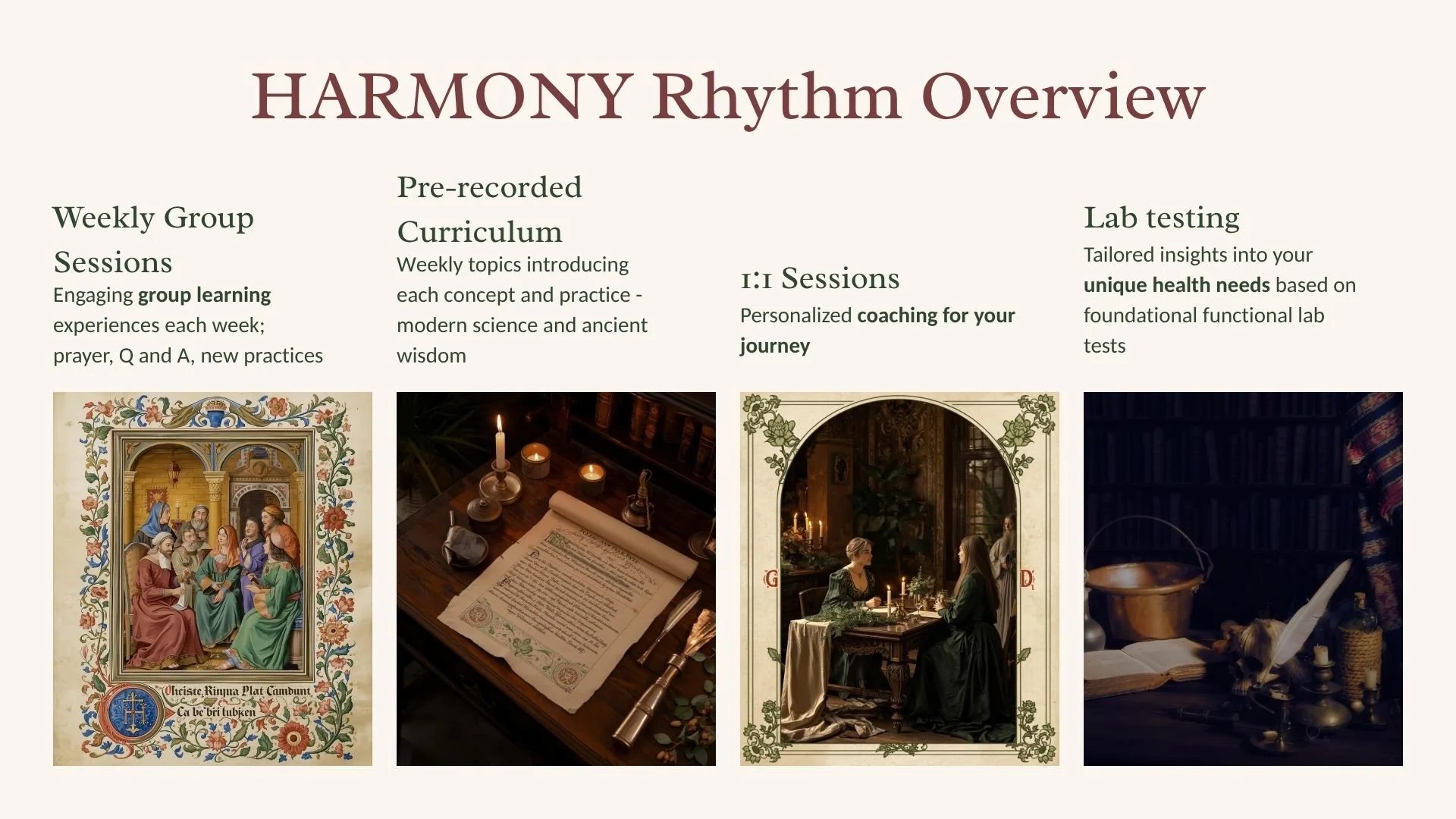
Join HARMONY to bring back the integrated human person into the fullness of your calling. Organize WORKSHOP to evangelize and introduce your group, parish, org to the healing way of life. Take a course to get your charismatic and mystical juices flowing.
P.S. Prophetic charismatic people and mystics/contemplative oriented toward supernatural. Bc you are prone to Gnosticism, over spiritualizing, illuminism, and can mistake massive hysteria with anointing, you should learn about historical appearances of movements that lead ppl astray bc their leaders were convinced about the true nature of their revelations.
You should guard your mind and heart, be very humble, seek spiritual advisors and directors, continually question your input, zealously pray for the right discernment, ask pastoral ppl to help you release and apply prophetic insights if approved and mostly, be steeped in praying the Scriptures and in the solid teaching of the Church. At all times, pursue virtuous lifestyle, wash the dishes, help the poor.
Otherwise, you will drift. That is certain. Bc pride and vainglory will fuel your soul as a ‘spirituality’ and a ‘fresh move of God.’ After few very accurate prophetic words, few flatterers will be in awe of your gift and soon your ego will sing praises to you. Individualized Jesus leads to individualized theology. You will get lost in yourself. Hildegard has your back in this.
Iwona Bednarz-Major November 21, 2025