Healing in the Paschal Mystery
Every year, spring arrives and wellness culture loses its mind. Detox challenges, the sudden, almost violent return to the gym, a desperate and slightly frantic conviction that this time will be different. And every year, by May, most of it has dissolved not because people lack willpower. But because they are trying to cross a threshold using a to-do list. Thresholds don't work that way. They need the pattern that will make it sensible.
Holy Week is such a sensible cosmic threshold, nit just a a liturgical obligation to endure before Easter brunch, but as the most precise map ever drawn of how new life actually arrives in a body, in a soul and spirit, in a whole human person. And if you think that's just spiritual language, you haven't met the science yet. Because it turns out that the paschal pattern, the death, the hiddenness, the resurrection, is not just the story of Christ. It is embedded in your cellular architecture. It is the shape of every genuine healing. It is what your body has been trying to do every time you let it and the Holy Week is the map.
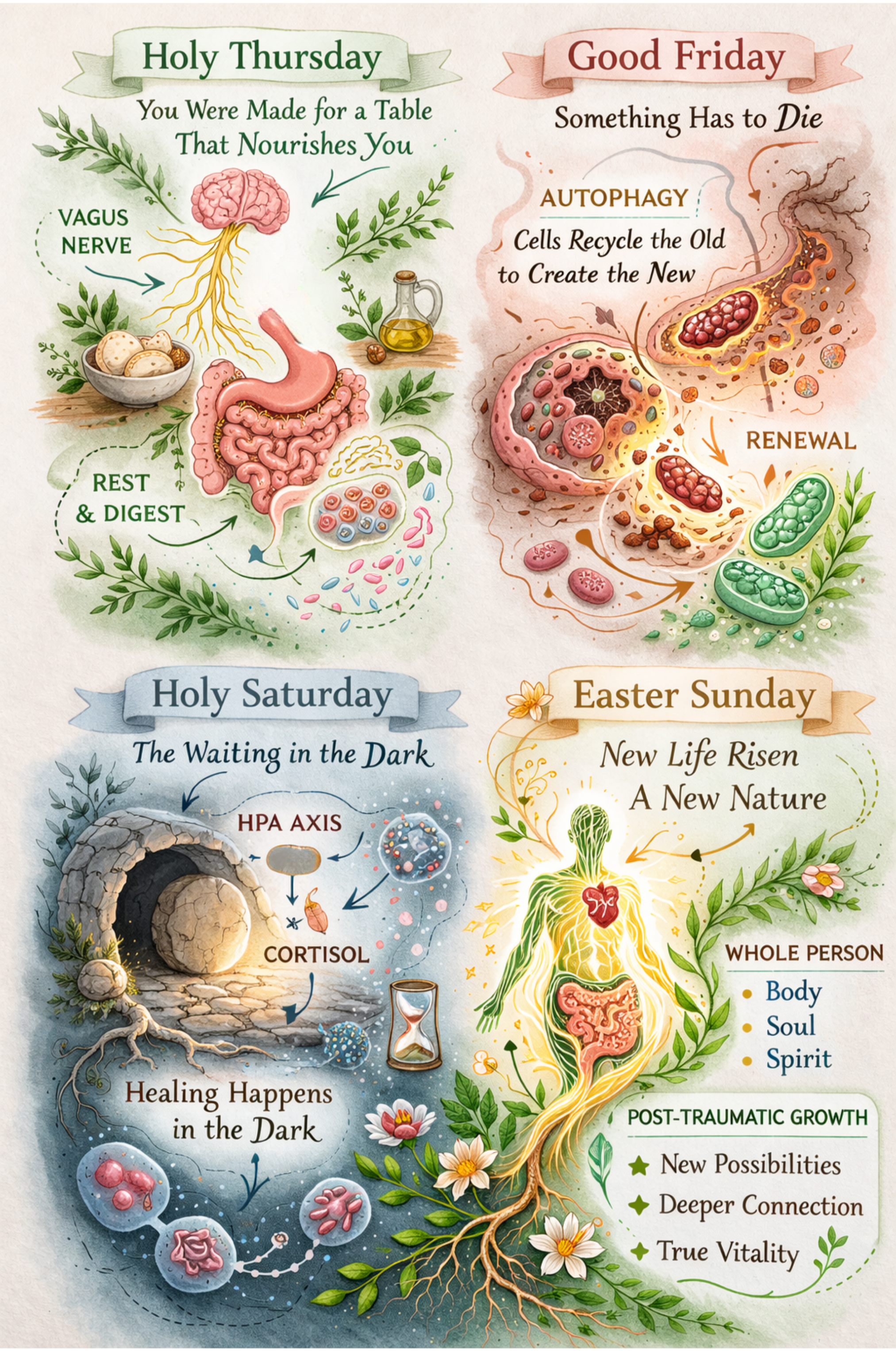
Holy Thursday: You Were Made for a Table That Actually Nourishes You
The Last Supper was not a nutrition seminar. But it was the most radical statement ever made about food that actually gives life. God, in the flesh, sits down at a table, takes bread, gives thanks, breaks it, and says: This is my body. He does not hand out a supplement protocol. He does not recommend intermittent fasting. He gathers people, blesses real food, and turns an ordinary meal into the permanent axis of Christian life. For Jesus to use food as the threshold between heaven and earth forever elevated created substance to have a meaning of uncreated presence of life-giving nourishment.
Hildegard of Bingen understood this more viscerally than most. For her, the meal was never merely physical. Food carried sufficient nourishment pulsing through created things. When you eat food that is real, ordered, and received with gratitude, something more than calories enters you. Modern nutrition science is catching up, slowly and awkwardly, to what she knew in the 12th century.
The vagus nerve, the body's primary parasympathetic (rest and digest) highway, running from the brainstem through the heart, lungs, and gut, governs what physiologists call "rest and digest." It regulates stomach acid production, bile release, digestive enzyme secretion, and gut motility. According to the Cleveland Clinic and NCBI anatomy reference, this nerve carries 75% of all parasympathetic fibers in the human body and is the main communication pathway between the gut and the brain.
Here is what that means at your dinner table: the vagus nerve is also the nerve most activated by safety, connection, singing, and prayer. The very things that happen at a table with people you love and trust. Chronic sympathetic activation, your "fight or flight" state, redirects blood flow away from the gut and suppresses the very digestive functions you need to actually absorb what you eat. A meal eaten in hurry, isolation, or anxiety is not the same meal as one eaten in community and gratitude. This is not poetic. This is gastroenterology. Hildegard would not be surprised. She consistently warned against eating in anger, sorrow, or exhaustion, not because she was moralistic about mealtimes, but because she understood what we are only now measuring: digestion is a relational act.
Holy Thursday tells us: before you can be broken open and given, you must first be genuinely fed. Not managed. Not supplemented. Not optimized but fed at a real table by a love that knows your name. A meal that changes your philosophy of life is not one where you count macros. It is one where something is given to you that you could not produce yourself. Where you receive, rather than perform. Where bread becomes more than bread, and you realize you have been hungry for something far deeper than you knew.
Good Friday: Something Has to Die. And Your Body Already Knows It.
Here is what no wellness program will tell you: real transformation requires an actual loss. Not a reframe, "letting go of what no longer serves you" delivered in a soothing podcast voice but an actual death. Something that was real, that mattered, that you gave energy to but must end so something new can live. Good Friday is not a metaphor. It is the event that makes all smaller deaths intelligible.
The science agrees with the theology here, and not vaguely. Autophagy — from the Greek auto (self) and phagein (to eat) is the cellular process by which the body identifies, dismantles, and recycles its own damaged or dysfunctional components. It is literally the body dying to itself at the cellular level in order to generate renewal. Yoshinori Ohsumi received the 2016 Nobel Prize in Physiology or Medicine specifically for uncovering the mechanisms by which this process works. His conclusion, in plain language: your cells must consume the old in order to create the new. They cannot do both simultaneously. The Nobel Committee noted that autophagy is activated by starvation, by lowered insulin, and by the kind of intentional deprivation the Church has prescribed on Fridays and during Lent. The Church was practicing Nobel Prize-winning biology before the Nobel Prize existed.
Hildegard was not working with electron microscopes, but she described this process with startling accuracy. In Causae et Curae, she wrote of the need for the body to "burn through" accumulated burdens, excess humors, stagnant patterns, congested life force before viriditas (vitality) could return. Her fasting prescriptions were not about punishment. They were about making space. The body cannot receive new life while holding onto what has already died.
But here is what makes Good Friday different from every detox protocol ever sold: The dying is not incidental. It is the point. Christ did not suffer accidentally on the way to resurrection. He walked into it, intentionally, with full knowledge of what it would cost. The Church has always taught that our own crosses are not interruptions to the spiritual life. They are the spiritual life. The problem is that most of us are trying to manage our deaths rather than die them. We hold onto lifestyle patterns we know are harming us because they are familiar. We maintain metabolic chaos because addressing it would require admitting something is wrong. We stay in spiritual desolation and call it busy because stillness means we'd have to feel what we've been outrunning.
What in you has been waiting for a Good Friday? Not as a journaling prompt but as a real question with a real answer that has probably been knocking on your interior door for longer than you would like to admit. The body often knows before the mind does. Chronic inflammation is a form of the body holding on. Gut permeability is the digestive system absorbing what it was never meant to absorb. These are the physiology of reluctance.
Good Friday is the invitation, liturgically, biologically, spiritually, to stop managing the dying and let it happen. To say, with full knowledge of the cost: Into your hands I commend my spirit. And then let something go.
Holy Saturday: The Most Uncomfortable Day in the Liturgical Year and in Your Lab Results
Nobody talks about Holy Saturday. We talk about the cross. We talk about the empty tomb. But that in-between day when the disciples sat in a sealed room, not knowing if anything was happening, not knowing if the story was over, this one gets skipped. Which is strange, because Holy Saturday is where most of us actually live: You have made the decision, changed your practices. You have let something die. And now? Nothing seems to be happening. You don't feel different, the lab results haven't shifted yet, the energy hasn't returned, the prayer still feels shallow. You are in the tomb, and the tomb is dark, and information is not enough. This is not failure but the most biologically accurate part of the entire sequence. Here is what is actually happening inside you during what looks like nothing:
The hypothalamic-pituitary-adrenal axis (HPA axis), which is your body's central stress-regulation system, takes weeks to months to meaningfully recalibrate after chronic dysregulation. Even after the stressor is removed, ACTH hormone (regulating metabolism, blood pressure, and stress response) responses remain blunted for weeks while cortisol is already normalizing. Full recovery of HPA axis dynamics occurs in phases: early withdrawal, intermediate withdrawal, and only then, late withdrawal, operating on a timescale that the person living it cannot feel from the inside.
In other words: the hormonal system heals on a schedule it does not share with you.
The gut microbiome requires consistent intervention over weeks before measurable diversity changes appear. Mitochondrial renewal unfolds through molecular signaling invisible to any symptom you might notice day to day. Your body heals in the dark.
Hildegard's understanding of healing was saturated with this patience. She prescribed not quick fixes but rhythms, seasonal adjustments, fasting periods, the slow cultivation of virtue alongside the slow repair of the body, because she assumed that the deepest healing happens below the surface, in time, without the consolation of visible progress.
The disciples on Holy Saturday had no idea that the most dramatic biological and spiritual event in human history was occurring in a sealed tomb. Everything was happening although nothing was visible. This is where most people abandon their healing. Not because the process stopped working but because it stopped feeling like it was working. Trust that transformation is happening in the dark. Remain. Don't leave the tomb site early.
Easter Sunday: New Life Is Not an Upgrade. It Is a Different Nature.
The resurrection is the most misunderstood event in history. We treat it like a comeback story. The Hero was down, now he's back. The team was losing, now they've won. But that is not what happened. The risen Christ was recognizable and simultaneously unrecognizable. He appeared in locked rooms, vanished during meal. His body was no longer bound by the physics that governed it before. He was the same person but His divinity was shining now through His humanity. This is what Paul means in 1 Cor 15: 42-44:
So is it with the resurrection of the dead. What is sown is perishable, what is raised is imperishable.It is sown in dishonor, it is raised in glory. It is sown in weakness, it is raised in power.It is sown a physical body, it is raised a spiritual body. If there is a physical body, there is also a spiritual body.
Not a repaired version of the old. A genuinely new creation. And this is precisely what happens when healing goes all the way.
Psychologists Richard Tedeschi and Lawrence Calhoun coined the term Post-Traumatic Growth in the 1990s to describe a phenomenon that non-professionals had recognized since ancient times but psychology had largely ignored: people who struggle with serious life crises do not just recover. A significant portion of them are transformed in ways that exceed their pre-crisis baseline. The five categories of growth they identified include new possibilities, stronger relationships, personal strength, spiritual deepening, and a changed philosophy of life.
It is not that the old energy returns; new relationship with the body develops, one that was never available before. It is not that the stress disappears; a nervous system capacity to move through stress without being consumed by it emerges. It is not that the old wounds are erased; they become, like the wounds of Christ, the very places through which light now passes. This is not because suffering is good. It is because the paschal pattern is embedded in the biology of the human person. We were made for it. Death and resurrection are not foreign to our cellular architecture.
Hildegard described the fully restored human person as one in whom viriditas (vitality) flows freely again, not as it did before disruption, but as it was originally designed to flow: energized, clear, rooted, spacious, capable of giving without depletion because the source is no longer the self alone, but the life of God moving through the whole person. And that is Easter Sunday. Not a wellness goal achieved. Not a body optimized. A whole person, body, soul, and spirit, returned to their original design.
The Threshold Is Open
Holy Week is not ancient history. It is the annual invitation for your body, your soul, and your spirit to do what they were designed to do: pass through death into life. But thresholds require accompaniment. You were not made to cross them alone.
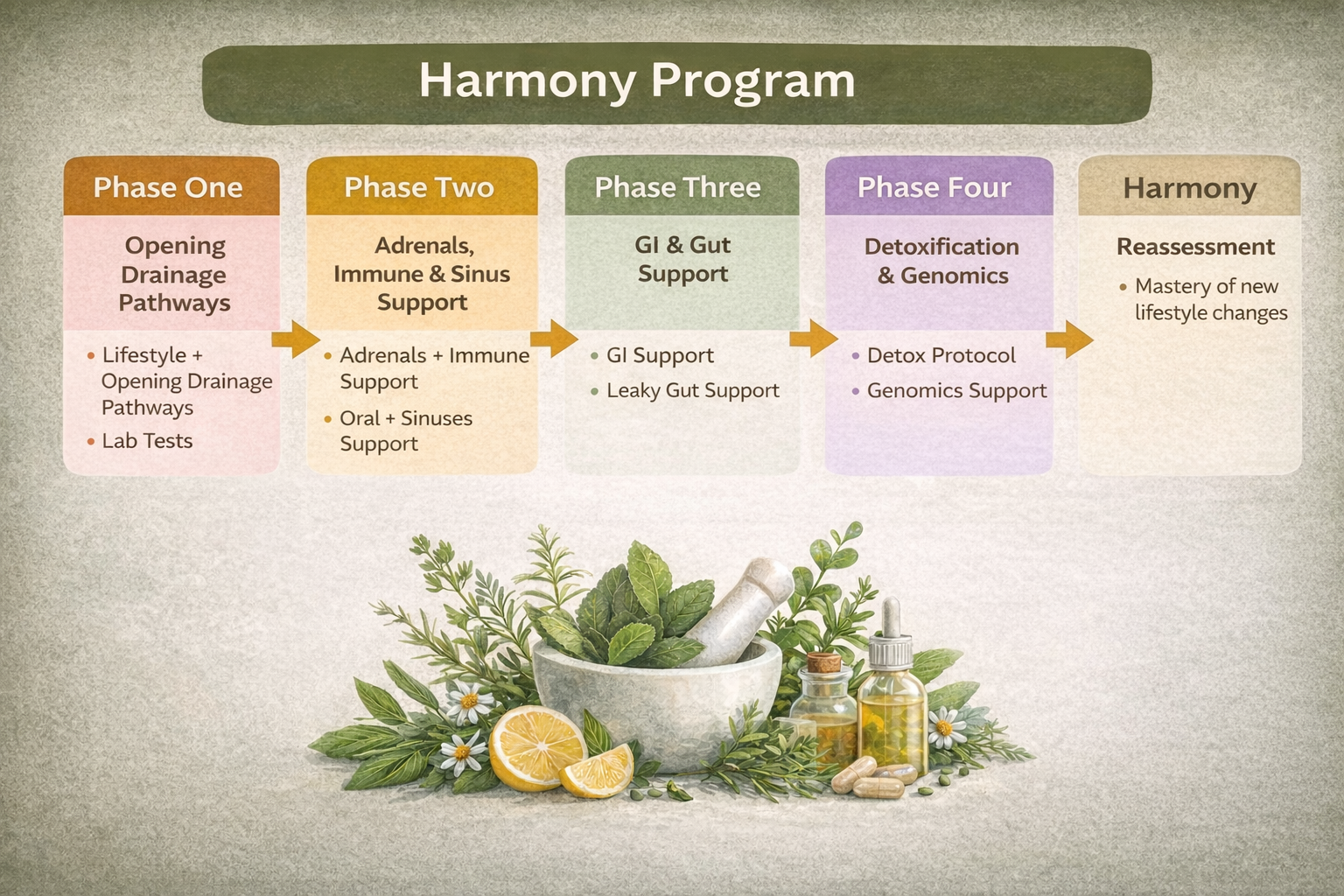
HARMONY, 12-week Structured Clinical Formation program beginning April 11. It was built for exactly this passage. Functional lab testing to see what your body is actually carrying. The Metabolic Typing Diet to nourish you in the way your specific biology requires. The wisdom of Hildegard's healing tradition to root all of it in the deeper order of who you are and Who made you. A community of people crossing the same threshold alongside you.
You need a Thursday. A Friday. A Saturday. And the courage to stay long enough for Sunday.
Book a free Strategy Call→ Learn more about HARMONY.
20% off the Spring Edition through March 31 only.
Sources
Anatomy, Autonomic Nervous System. StatPearls. National Center for Biotechnology Information (NCBI). Updated December 2025.
Cleveland Clinic. "Vagus Nerve." Medical review, January 2022.
Omer Karin, Moriya Raz, Avichai Tendler, Alon Bar, Yael Korem Kohanim, Tomer Milo, Uri Alon "A new model for the HPA axis explains dysregulation of stress hormones on the timescale of weeks." Molecular Systems Biology, 2020. PMC7364861.
Nobel Prize Committee. "The Nobel Prize in Physiology or Medicine 2016 – Press Release." NobelPrize.org, October 2016.
Levine, B. & Klionsky, D.J. "Autophagy wins the 2016 Nobel Prize in Physiology or Medicine." PNAS, 2016. PMC5240711.
Tedeschi, R.G. & Calhoun, L.G. "Posttraumatic Growth: Conceptual Foundations and Empirical Evidence." Psychological Inquiry, 15(1), 2004.
Tedeschi, R.G. & Calhoun, L.G. "The Posttraumatic Growth Inventory: Measuring the positive legacy of trauma." Journal of Traumatic Stress, 9(3), 1996.
American Journal of Medicine. "An Integrative Approach to HPA Axis Dysfunction: From Recognition to Recovery." June 2025.